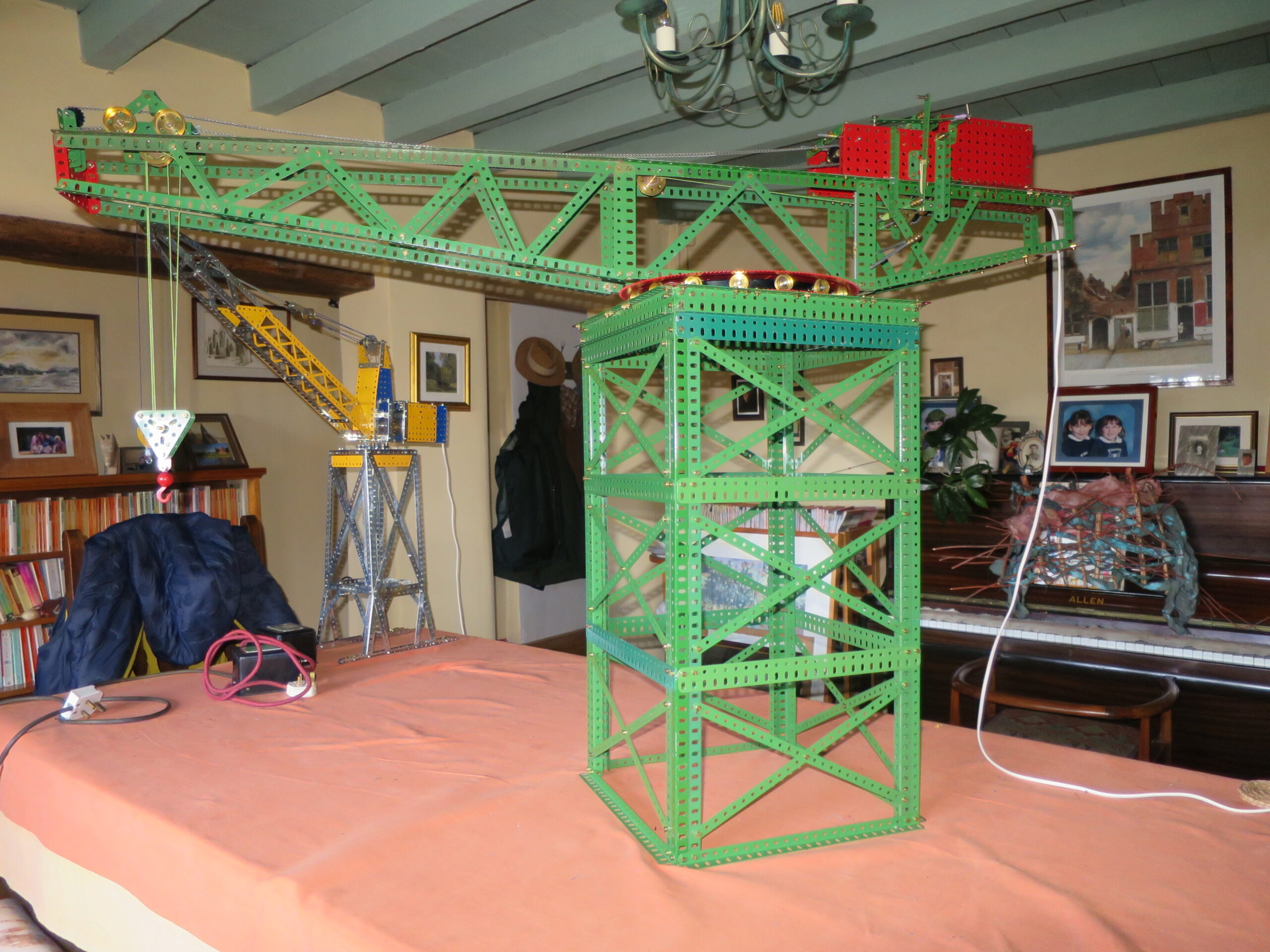
Meccano Hammerhead Crane

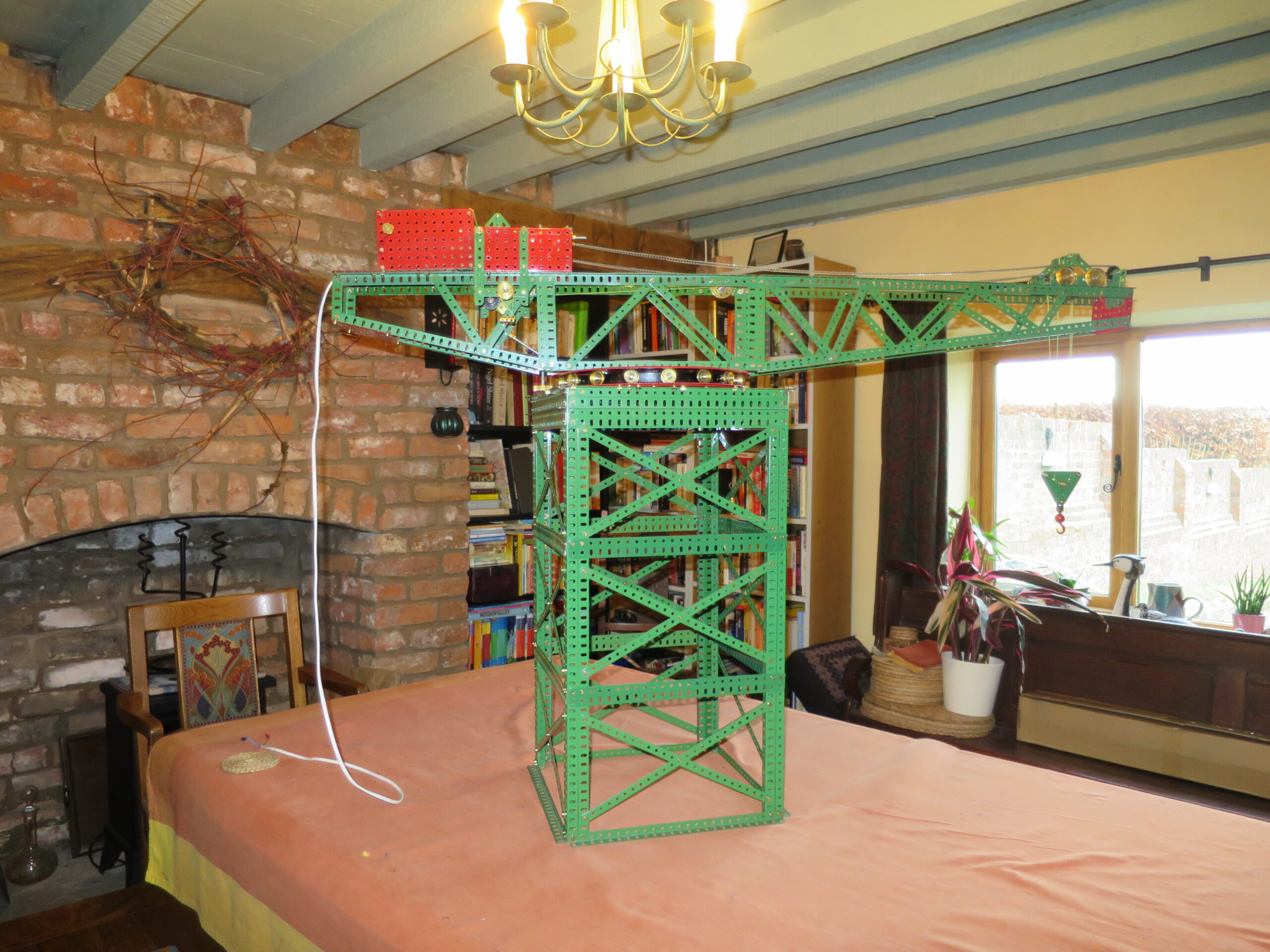
November 2023. Time for my second Super Model build. I’ve got a Roller bearing and I’m going to use it. Well I’d bought the bearing so I had to build a crane, hadn’t I? I picked the hammerhead crane model because it looked big. And it is. Relatively simple though, and a bit of a relief after wrestling with a double decker bus. And it does look good. And it works.

Some pictures:
Build notes

Most of this build was pretty straightforward, apart from a serious mistake in the text. The section on ‘Building the boom’ starts with the sentence ‘The main girders of the boom 7 and 8 are each built up from two 24.5″ Angle Girders overlapping two holes.’ This just doesn’t work. They end up 1″ too short, and even if it worked the traveller would jump every time it hit the overlap. If you butt the girders together and join them with 5.5″ strips the problems go away and everything fits. That took me a long time to sort out, but I got there in the end.

The other tricky bit was the motor cover. It’s fiddly to fit, as it’s more or less a closed box so you can’t get at the inner nuts easily. And I had to keep taking it off to fettle the mechanism. I got there in the end though.

I had to do a bit of modification to stop the gears dropping out: as standard you have to hold the levers in place to keep the cogs meshed. Aren’t rubber bands wonderful things?

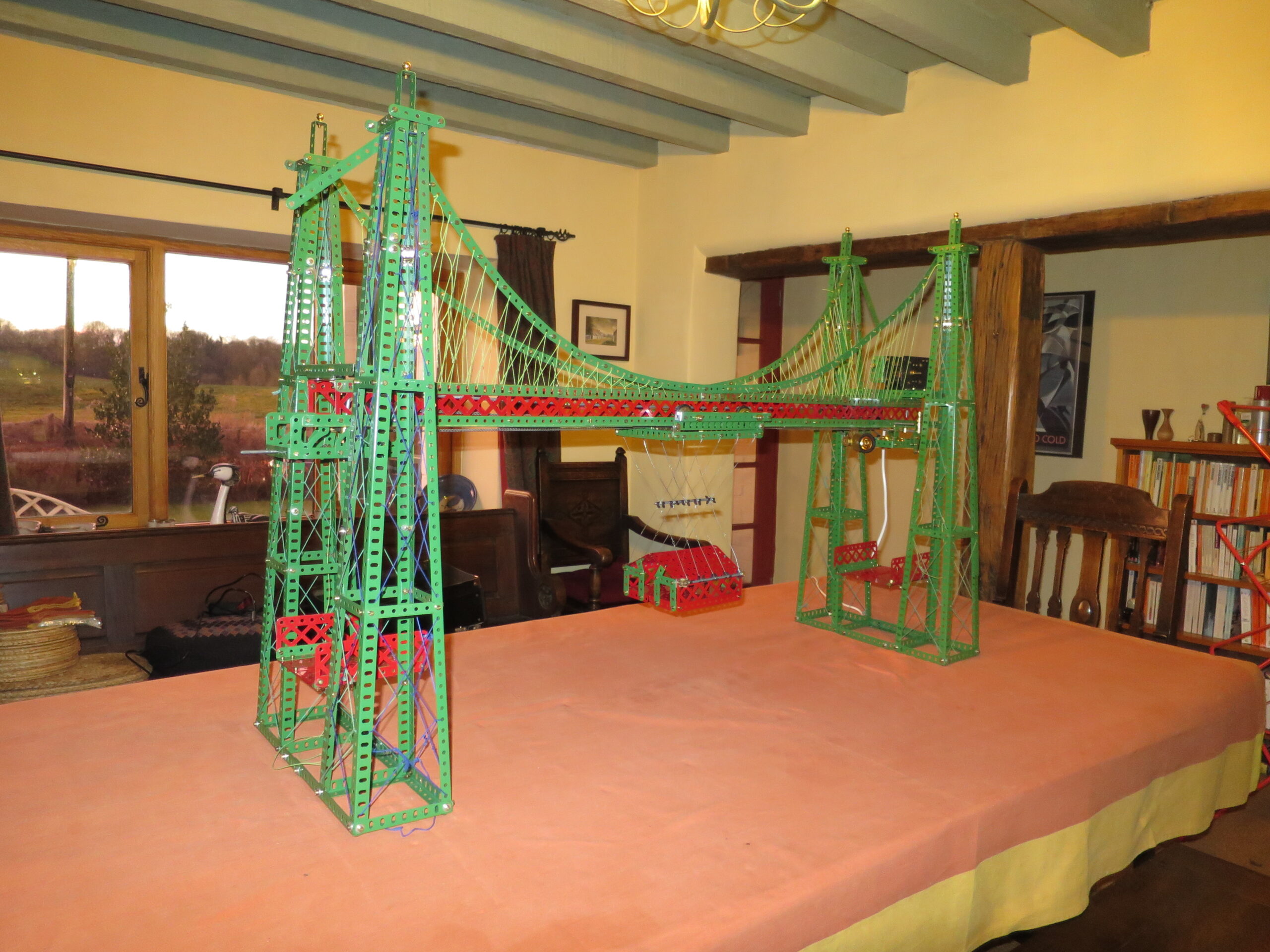
Meccano Transporter Bridge

Introduction

There were earlier, simpler, Meccano models of a transporter bridge, but the Super Model version first appeared in the 1918 Meccano Instruction Book 2, as far as I can tell. The Super Model version has only small changes from this earlier model.

This was my first Super Model build, February 2023. I needed to buy a few extra bits, particularly more braced girders. I wanted to build this one because it was based on the transporter bridge that used to be near here, crossing the Mersey from Runcorn to Widnes. I never saw the original bridge, which was completed in 1905 and replaced in 1961. And before 1905?…

‘On the banks of the Mersey, over on Cheshire side,

Lies Runcorn that’s best known to fame

By Transporter Bridge as tak’s folk over its stream,

Or else brings ’em back across same.

In days afore Transporter Bridge were put up

A Ferry Boat lay in the slip,

And old Ted the Boatman would row folks across

At per tuppence per person per trip.

Now Runcorn lay over on one side of stream

And Widnes on t’other side stood,

And as nobody wanted to go either place,

Well, the trade wasn’t any too good.’

…from ‘Runcorn Ferry’ by Marriott Edgar. Believe that as you will.

Anyway, here’s the model:

Build notes

Meccano parts lists often aren’t accurate – I’m starting to get that now. This time there was a crucial mistake in the text too. ‘Each of the lower girders 3, on which the carriage 30 (Fig. 1) travels, consists of one 24.5″, one 12.5″, and one 9.5″ Angle Girders bolted to Braced Girders 4’ doesn’t work, as the composite girder needs to be 49.5″ long. This took me quite a bit of puzzling out, but I ended up using 3 overlapped 18.5″ girders instead. The carriage kept jumping off its girders, so I replaced the flanged wheels with 1″ pulleys fitted with rubber rings, which worked a lot better. The crank handle used in the mechanism to flip-flop the reversing action fouled the string bracing, so I replaced it with an alternative slimmer solution built from couplings, threaded pins, a 1.5″ strip and a 1″ rod. Those were the main tweaks. The string bracing took some time, but I found it curiously satisfying to do. This build was when I found out that Meccano cranks often aren’t up to the job – the boss often rotates, making them useless as a lever.

Having said all that, I really enjoyed the build, including the challenges. The finished model looked great, occupying the whole of our dining room table. And yes it really did go backward and forwards repeatedly on automatic, including a pause each time to allow for loading and unloading. Eventually.